From firehose to five: how the Safety Inbox changes a manager's morning
 Tom Halloran, Product · 15 January 2026 · 5 min read
The dirty secret of fleet video is that almost nobody watches it. A camera on every vehicle sounds like total visibility, but a fleet of fifty trucks generates thousands of triggered events a week, and a safety manager has perhaps an hour a day to spend on them. The footage exists. The review does not happen. The risk sits unread.
This matters because the safety benefit of video does not come from recording events. It comes from acting on them. In an FMCSA-funded field test of an onboard monitoring system across four fleets and 317 drivers, pairing video with feedback and coaching reduced safety events by roughly 55% for less-severe and 60% for more-severe events (FMCSA / VTTI). The camera was necessary. The coaching conversation was what changed behaviour, and that conversation only happens if someone reviews the clip.
Recording an event is worth nothing. Acting on it is worth roughly a 55–60% drop in events.
Triage, not a video graveyard
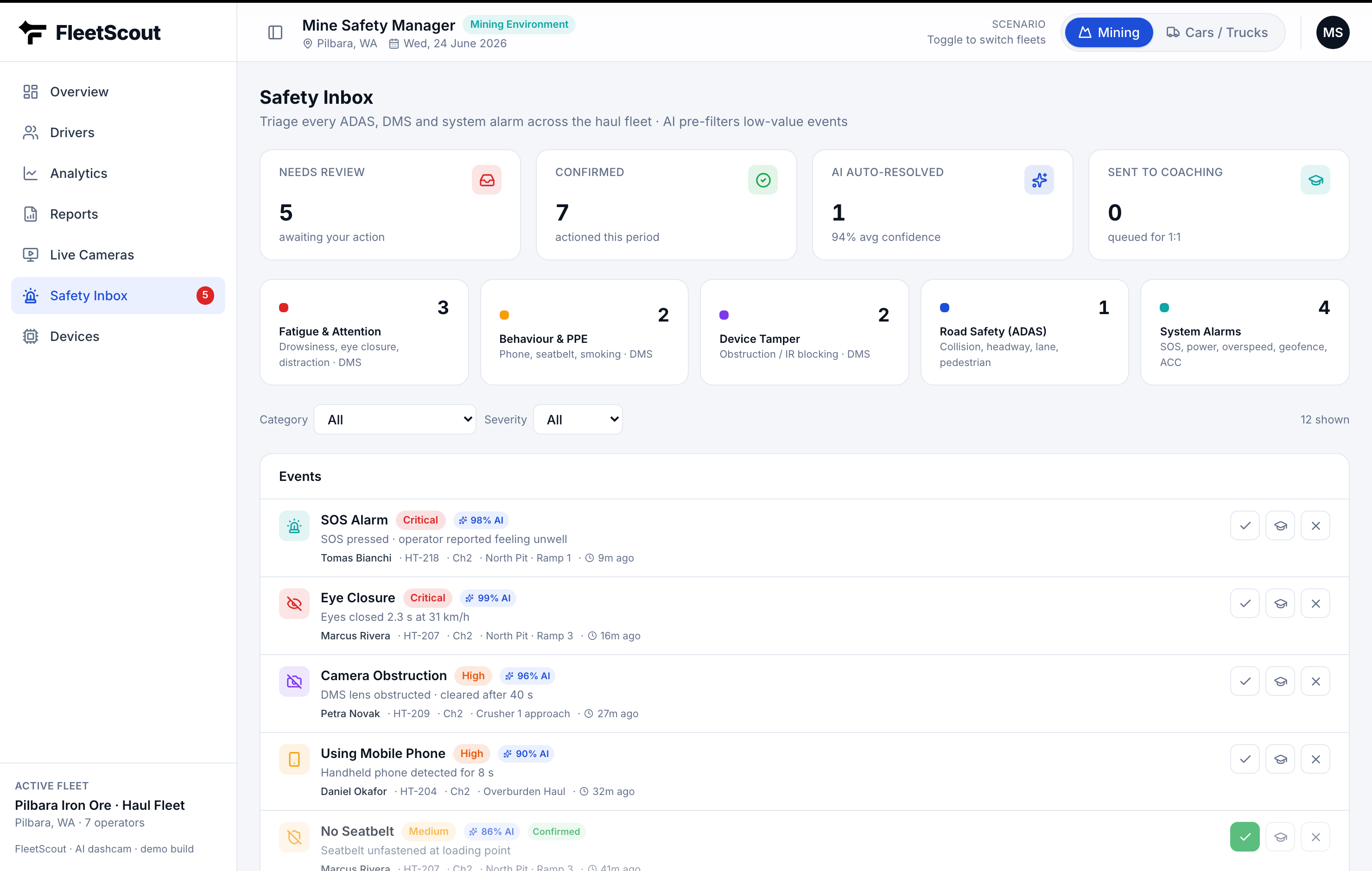
The Safety Inbox is built around one assumption: the manager's attention is the scarcest resource in the system. So the job of the software is to spend it well. Every triggered event gets an AI confidence score. The obvious noise, a shadow, a brief glance already self-corrected, is auto-resolved and stays out of the way. What lands in the inbox is the short list that genuinely needs a human decision, each with the clip attached and one of three actions: confirm, send to coaching, or dismiss.
A ranked queue, not a feed
The inbox shows what needs review now, what's been confirmed, what the AI auto-resolved, and what's queued for a coaching session, so a manager works the top of the list and stops, instead of scrolling forever.
Monday, 7:04am
A regional logistics manager opens the inbox with a coffee. Overnight produced forty-one triggered events. Thirty-six were auto-resolved with high confidence. Five are waiting: a handheld-phone event at 98 km/h, a forward-collision hard-brake, two seatbelt-off-between-drops, and one camera-obstruction. She confirms the phone event and sends it to coaching, dismisses a false seatbelt trigger, and flags the obstruction for the depot. Six minutes, done, and the two drivers who actually needed attention will hear about it today, not at next month's review.
That is the whole shift in mindset: from "watch everything and miss most of it" to "act on the five that matter." The firehose becomes a worklist, and the worklist actually gets worked.
Sources
- FMCSA / VTTI, Onboard Monitoring System field test. rosap.ntl.bts.gov
Work the five that matter
Open the Safety Inbox and triage a real event queue with confirm, coach and dismiss.
Open Control Panel